
Introduction
Cybersecurity has changed dramatically over the past decade. Traditional network security models relied on a simple assumption: everything inside an organization’s network could generally be trusted, while threats mostly came from outside. However, with cloud computing, remote work, mobile devices, and increasingly sophisticated cyberattacks, that assumption no longer holds true.
Today, businesses operate across multiple cloud platforms, employees access company resources from anywhere, and applications are distributed across data centers and edge locations. Attackers exploit stolen credentials, compromised devices, and unsecured applications to move laterally within networks once they gain access.
This evolving threat landscape has made Zero Trust Network Architecture (ZTNA) one of the most important cybersecurity strategies in modern IT. Instead of assuming trust based on network location, Zero Trust follows one fundamental principle:
Never Trust, Always Verify.
Every user, device, application, and network connection must be authenticated, authorized, and continuously validated before access is granted.
In this comprehensive guide, you’ll learn:
- What Zero Trust Network Architecture is
- Why traditional security models are becoming outdated
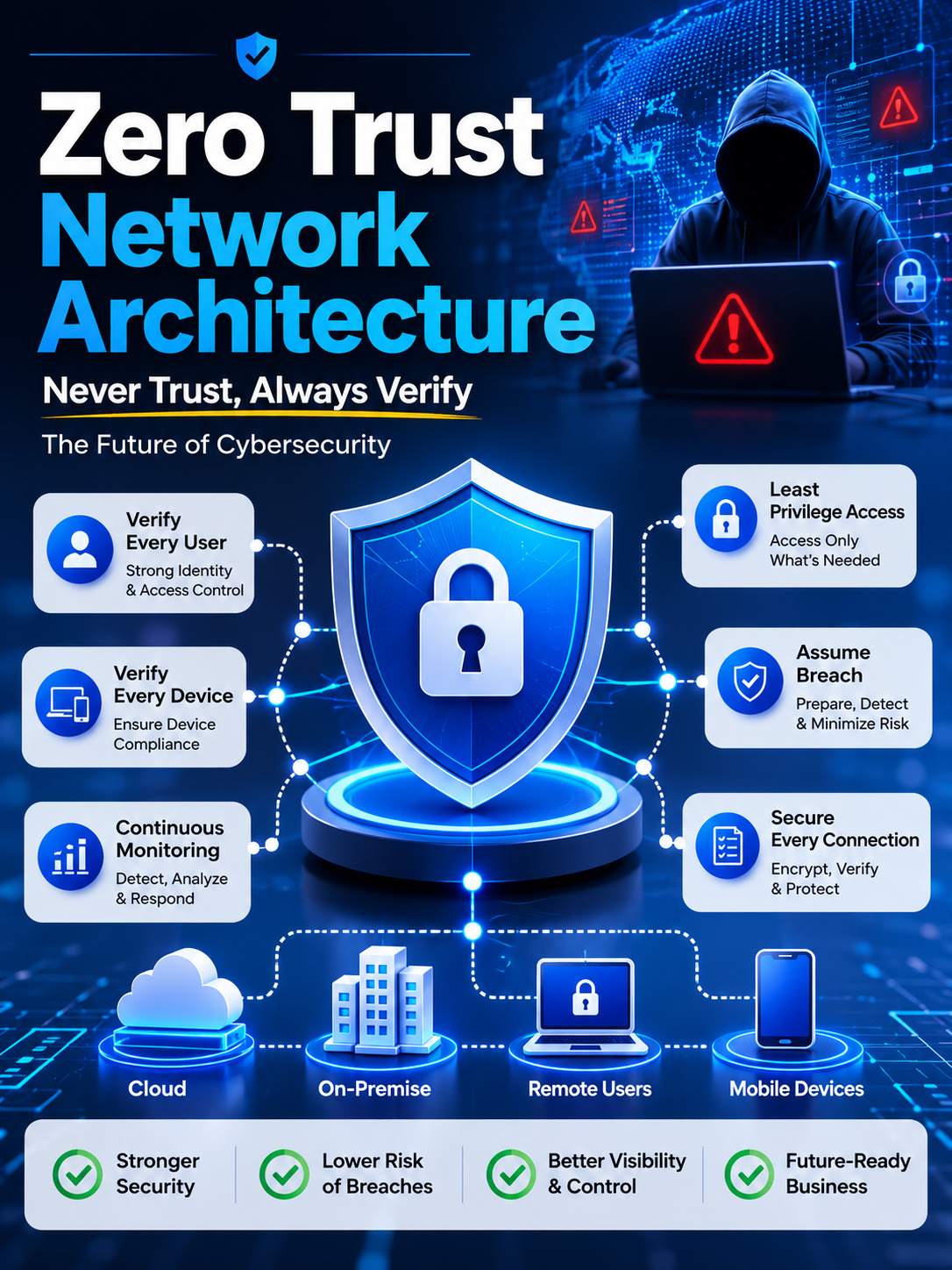
- Core Zero Trust principles
- How Zero Trust works
- Key technologies involved
- Benefits and challenges
- Real-world implementation examples
- Best practices for organizations
What Is Zero Trust Network Architecture?
Zero Trust Network Architecture (ZTNA) is a cybersecurity framework that assumes no user, device, or application should be trusted automatically, even if it is inside the corporate network.
Unlike traditional perimeter-based security, Zero Trust treats every access request as potentially risky and requires verification every time access is requested.
Instead of asking:
“Is this request coming from inside the company?”
Zero Trust asks:
- Who is requesting access?
- Which device are they using?
- Is the device secure?
- What resource are they trying to access?
- Is this behavior normal?
- Should this access be allowed right now?
Only after verifying these factors is access granted.
Why Traditional Network Security Is No Longer Enough
Traditional security relied heavily on firewalls and VPNs.
The architecture looked like this:
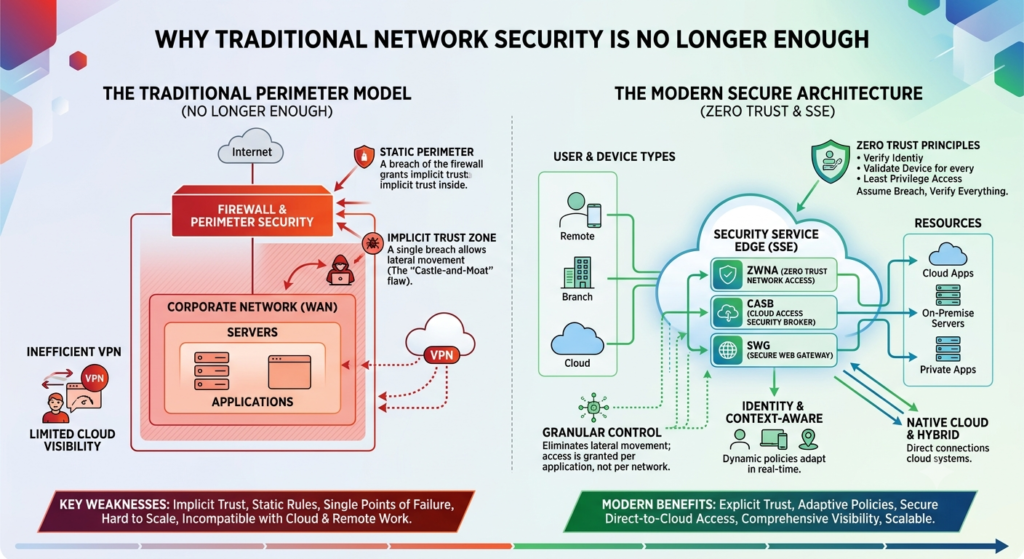
Once users successfully authenticated through the VPN, they often gained broad access across internal systems.
This approach worked when:
- Employees worked in offices.
- Applications stayed inside company data centers.
- Few cloud services existed.
Today’s environment is very different.
Organizations now use:
- Microsoft 365
- Google Workspace
- AWS
- Azure
- SaaS applications
- Remote employees
- BYOD (Bring Your Own Device)
- IoT devices
Attackers no longer need to break through the firewall—they often log in using stolen credentials.
This is why perimeter-based security alone is no longer sufficient.
The Core Principle: Never Trust, Always Verify
Zero Trust replaces implicit trust with continuous verification.
Instead of granting unlimited access after login, every request is evaluated individually.
For example:
Employee requests access to:
Payroll System
The Zero Trust platform checks:
✓ User identity
✓ Multi-factor authentication
✓ Device health
✓ Device location
✓ User role
✓ Time of access
✓ Risk score
Only after all security checks pass is access granted.
If risk increases during the session, access can immediately be revoked.
Core Principles of Zero Trust Architecture
1. Verify Every User
Every login must be authenticated.
Common verification methods include:
- Password
- Multi-Factor Authentication (MFA)
- Biometric authentication
- Security keys
- Identity providers
Identity becomes the new security perimeter.
2. Verify Every Device
Not every device should access sensitive information.
Organizations evaluate:
- Operating system version
- Antivirus status
- Disk encryption
- Device compliance
- Security patches
- Device ownership
Unmanaged or compromised devices receive restricted access.
3. Least Privilege Access
Users receive only the permissions necessary for their job.
Instead of:
Administrator Access
Users receive:
- Read-only
- Department-specific
- Time-limited
- Role-based access
This significantly limits attacker movement.
4. Assume Breach
Zero Trust assumes attackers may already be inside the network.
Security controls focus on:
- Limiting damage
- Detecting unusual activity
- Preventing lateral movement
- Rapid incident response
5. Continuous Monitoring
Verification never stops after login.
Security systems constantly evaluate:
- Login behavior
- File access
- Device changes
- Network activity
- Risk levels
Access decisions change dynamically based on new information.
How Zero Trust Network Architecture Works
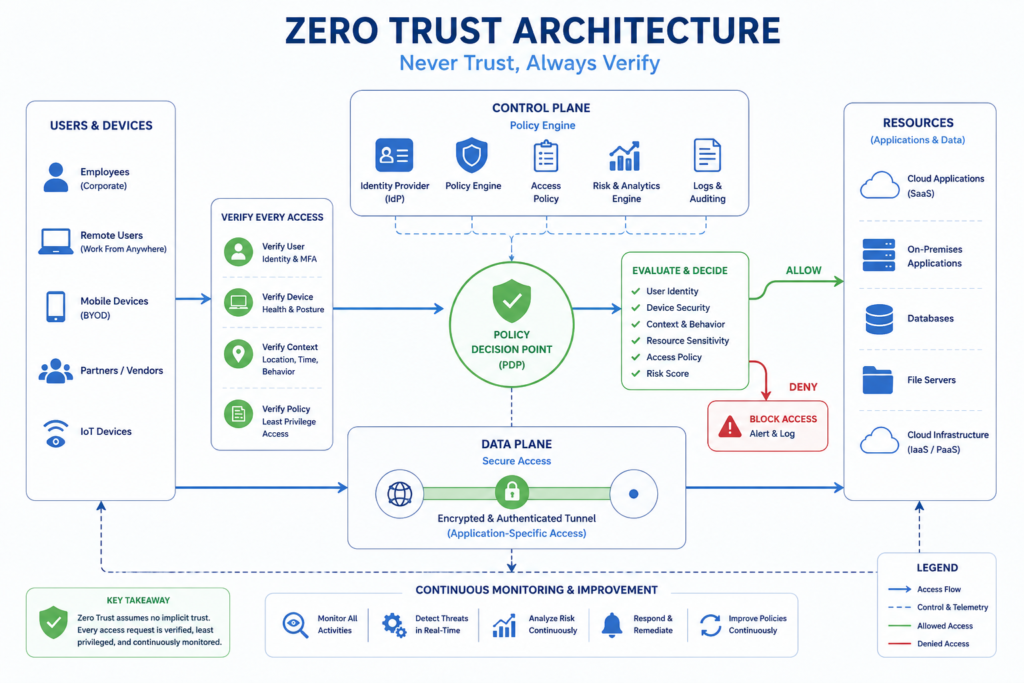
Key Components of a Zero Trust Architecture
A successful Zero Trust implementation combines multiple technologies.
Identity and Access Management (IAM)
IAM ensures that only verified users access organizational resources.
Features include:
- Single Sign-On (SSO)
- MFA
- User lifecycle management
- Role-based access control
Multi-Factor Authentication (MFA)
Passwords alone are no longer enough.
MFA combines:
- Something you know (password)
- Something you have (phone or security key)
- Something you are (fingerprint or face recognition)
Endpoint Security
Endpoints include:
- Laptops
- Smartphones
- Tablets
- Servers
- IoT devices
Endpoint protection detects malware and verifies device health before granting access.
Network Segmentation
Instead of one large network, Zero Trust divides infrastructure into smaller protected segments.
Benefits include:
- Reduced attack surface
- Limited lateral movement
- Better access control
- Faster incident containment
Security Information and Event Management (SIEM)
SIEM platforms collect and analyze logs from:
- Servers
- Firewalls
- Endpoints
- Applications
- Cloud platforms
This enables real-time threat detection and incident response.
Zero Trust Network Access (ZTNA)
ZTNA replaces traditional VPNs by connecting users directly to authorized applications rather than exposing the entire internal network.
Key advantages include:
- Application-specific access
- Reduced attack surface
- Better visibility
- Adaptive access policies
- Improved remote work security
Benefits of Zero Trust Network Architecture
Organizations adopting Zero Trust gain several advantages:
Stronger Security
Every request is validated, reducing unauthorized access.
Reduced Insider Threats
Even trusted employees receive only the access they require.
Better Remote Work Security
Employees can securely work from anywhere without relying solely on traditional VPNs.
Reduced Lateral Movement
Attackers cannot easily move between systems because access is tightly controlled.
Improved Compliance
Zero Trust supports regulatory requirements such as GDPR, HIPAA, PCI DSS, and ISO 27001 through stronger identity, access control, and audit capabilities.
Better Visibility
Security teams gain detailed insight into users, devices, applications, and access patterns.
Common Challenges
While powerful, Zero Trust is not implemented overnight.
Organizations often face challenges such as:
- Legacy applications that lack modern authentication
- Complex policy design
- Integration across multiple cloud providers
- User adoption and training
- Upfront investment in security tools
- Ongoing monitoring and maintenance
A phased rollout usually delivers the best results.
Real-World Example
Imagine an employee working from home.
They log in using MFA on a company-managed laptop with current security updates.
They request access to the finance application.
The Zero Trust platform verifies:
- Identity
- Device compliance
- User role
- Geographic location
- Risk level
Access is granted only to the finance application.
Later, the same account attempts to access engineering systems from an unfamiliar device in another country. The platform detects elevated risk and blocks the request, prompting additional verification and alerting the security team.
Best Practices for Implementing Zero Trust
- Inventory users, devices, applications, and data.
- Enforce Multi-Factor Authentication across all critical systems.
- Apply least-privilege access using role-based permissions.
- Continuously monitor users, devices, and network activity.
- Segment networks to contain potential breaches.
- Keep systems patched and devices compliant.
- Automate threat detection and response where possible.
- Regularly review and update access policies.
The Future of Zero Trust
As organizations continue adopting cloud-native applications, artificial intelligence, hybrid work, and connected devices, Zero Trust will become a foundational element of enterprise cybersecurity rather than an optional enhancement.
Emerging trends include:
- AI-assisted threat detection
- Risk-based adaptive authentication
- Passwordless authentication
- Identity-centric security
- Integration with Secure Access Service Edge (SASE)
- Continuous authorization based on real-time context
Organizations that embrace Zero Trust today are better positioned to defend against tomorrow’s threats.
Conclusion
Zero Trust Network Architecture represents a significant shift from traditional perimeter-based security to an identity- and context-driven model. By adopting the principle of “Never Trust, Always Verify,” organizations can better protect users, devices, applications, and data in a world where work happens everywhere and threats evolve continuously.
Although implementing Zero Trust requires planning, investment, and ongoing management, the benefits—stronger security, reduced attack surface, improved visibility, and better support for modern work environments—make it one of the most effective cybersecurity strategies available today.
Businesses of all sizes should view Zero Trust not as a single product but as a long-term security strategy that evolves alongside their infrastructure and risk landscape.