
Artificial intelligence has largely been defined by models that generate something.
Chatbots generate text. Image models generate pictures. Coding assistants generate code. AI video systems generate videos.
But a newly launched AI model called Jev is taking a different approach.
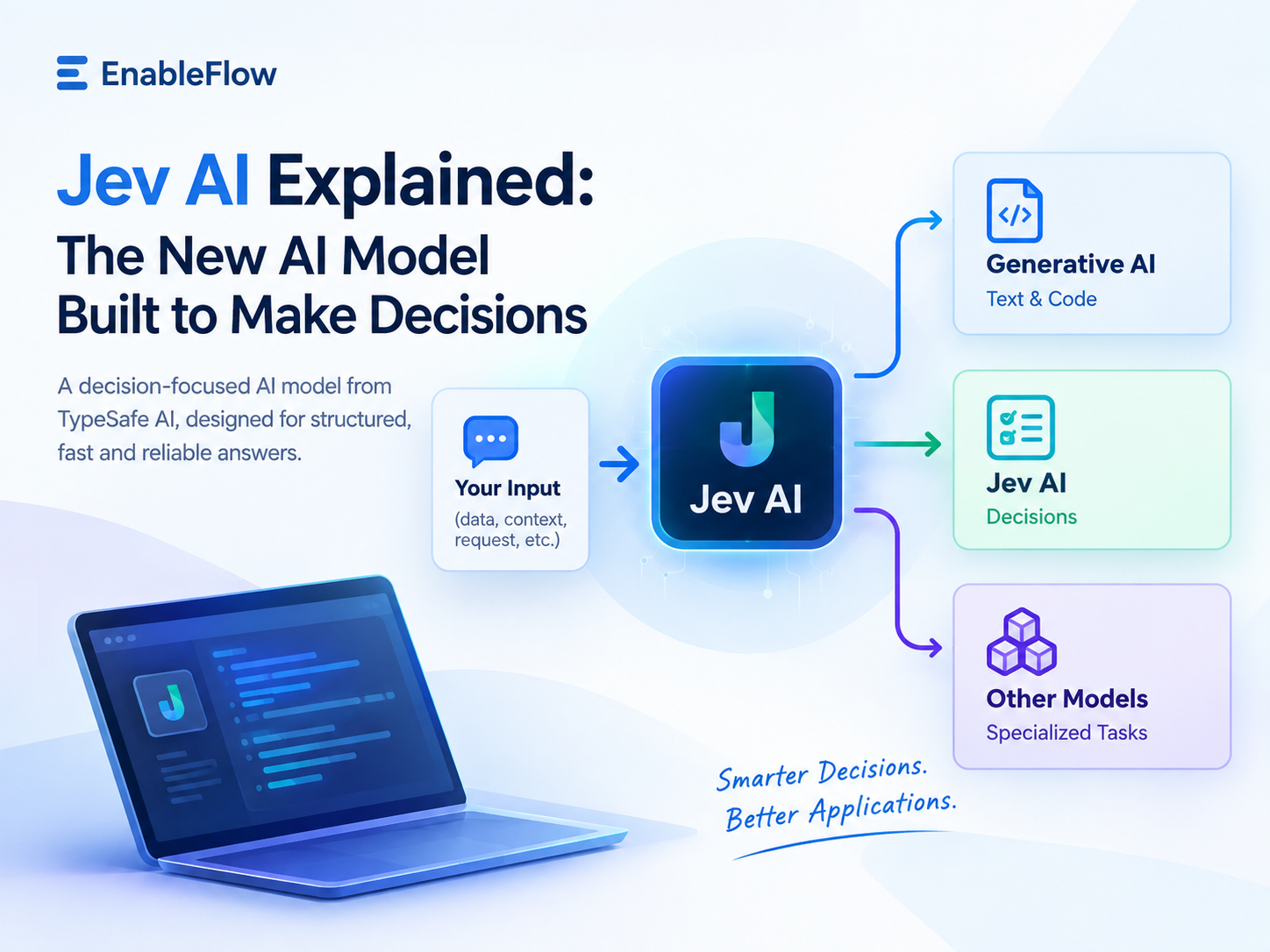
Developed by TypeSafe AI, Jev is designed to make structured decisions rather than generate paragraphs of text. Instead of asking an AI model to write an answer and then having software interpret that answer, developers can give Jev a situation and a predefined set of possible decisions.
The result is a structured decision that software can use directly.
Jev was launched in September 2026 and has attracted attention from developers because of its focus on speed, structured outputs, and decision-making inside software systems.
So, what exactly is Jev AI, how does it work, and why could decision-focused AI become important?
Let’s break it down.
What Is Jev AI?
Jev is an AI decision model developed by TypeSafe AI.
Unlike conventional large language models (LLMs), Jev is not primarily designed to generate natural-language responses.
Instead, it is designed to evaluate information and return a predefined type of result.
For example, imagine a customer-support system receiving this message:
“I was charged twice for my subscription this month.”
A traditional LLM could analyze the message and respond:
“This appears to be a billing issue. The customer should be transferred to the billing department.”
Jev approaches the problem differently.
A developer could define possible categories such as:
- Billing
- Technical Support
- Account
- Sales
Jev can then select the appropriate category and provide a probability or confidence signal.
The application can immediately use that result to route the customer.
This is the fundamental idea behind Jev: AI makes a decision, while the surrounding software determines what happens next.
Jev AI vs Traditional AI Models
To understand Jev, it helps to understand how most modern AI applications work.
Large language models are designed to generate sequences of tokens.
You provide an instruction, the model processes the context, and it generates an answer.
This makes LLMs extremely useful for:
- Writing
- Coding
- Summarization
- Translation
- Research
- Brainstorming
- Conversational assistants
But many software systems do not actually need a paragraph.
They need a decision.
For example:
Should this email be classified as spam?
Which support team should receive this ticket?
Should this transaction receive additional review?
Which AI agent should handle this task?
Is this action safe to execute automatically?
For these situations, generating a long natural-language answer can introduce unnecessary processing and parsing.
Jev is designed around this narrower problem.
How Does Jev AI Work?
The basic Jev workflow can be thought of as:
Application Data → Jev → Structured Decision → Software Action
A developer provides Jev with information about the current situation and defines the type of answer the application expects.
Instead of allowing the model to invent an arbitrary response, the possible output is constrained.
For example:
Input:
“Customer says their payment failed.”
Possible decisions:
– Billing
– Technical Support
– Account
– Sales
Jev:
Billing
Confidence:
High
The application can then automatically route the request to the appropriate workflow.
This architecture is particularly useful when an AI model sits inside a larger software system.
Jev’s Three Main Decision Types
Jev’s documentation describes several structured question types, including Choice, Score, and Noul.
1. Choice
A Choice question asks the model to select one option from a predefined list.
For example:
Question:
Which department should handle this request?
Options:
– Billing
– Technical
– Sales
– Account
The model selects one of those options.
This can be useful for:
- Customer-support routing
- Email classification
- Content categorization
- AI-agent routing
- Ticket management
The important point is that the model is choosing from the options supplied by the application.
2. Score
A Score question can be used when the application needs an ordered assessment.
For example, a company could define an urgency scale:
1 = Low
2 = Medium
3 = High
An incoming incident could then be evaluated against that scale.
This makes the model useful for workflows where software needs more than a simple category.
Examples include:
- Incident prioritization
- Lead scoring
- Risk assessment
- Content evaluation
- Customer-request urgency
3. Noul
Jev also supports a yes/no-style probability called Noul.
Instead of simply returning:
Yes
or:
No
the system can return a probability representing its assessment.
This can allow developers to create their own thresholds.
For example:
Probability: 0.94
A developer could decide that results above a particular threshold can proceed automatically, while uncertain cases should be reviewed by a human.
That distinction is important for production AI systems.
Why Is Jev Different From ChatGPT and Other LLMs?
The biggest difference is the output.
A traditional LLM is built to generate language.
Jev is designed to return structured decisions.
Consider an example.
A developer wants to determine whether an incoming message should be sent to a human employee.
With an LLM, the application might ask:
“Does this request require human review? Explain your reasoning.”
The model might return several sentences.
The application then needs to extract the actual decision.
With a decision model, the desired output can be defined beforehand:
Human Review Required:
Yes / No
The software receives a structured result that can immediately be used.
This difference makes Jev less of a replacement for conversational AI and more of a decision layer that can work alongside other AI systems.
Jev AI Is Not Designed to Replace Chatbots
It is important not to think of Jev as simply another competitor to ChatGPT or Claude.
The models are designed for different jobs.
A chatbot is useful when a person wants to interact with AI.
For example:
“Explain how cloud computing works.”
A generative AI model can produce a detailed explanation.
Jev is aimed at a different question:
“Which category does this request belong to?”
The answer might simply be:
Cloud Networking
There is no need for a long explanation.
This distinction can be summarized as:
| Task | Generative AI | Jev |
| Write an article | Suitable | Not designed for this |
| Generate code | Suitable | Not designed for this |
| Have a conversation | Suitable | Not designed for this |
| Classify a request | Possible | Designed for this |
| Route a ticket | Possible | Designed for this |
| Score an input | Possible | Designed for this |
| Make predefined decisions | Possible | Core use case |
| Return structured decisions | Possible with additional handling | Core design |
The two approaches can therefore complement each other rather than existing as direct substitutes.
Why Speed Matters in AI Applications
AI systems are increasingly being placed inside applications that handle thousands or millions of decisions.
Consider an online service processing:
- Customer tickets
- Security alerts
- Search requests
- Transactions
- API requests
- AI-agent actions
If every small decision requires a large generative model to produce a lengthy response, latency and cost can become significant.
Jev’s design focuses on making these smaller decisions quickly.
TypeSafe describes Jev as a System One model, with the company emphasizing low latency and structured outputs. Its current website lists an early-access system and quotes latency in the tens to hundreds of milliseconds depending on the task.
That makes the concept particularly interesting for software developers.
Where Could Jev AI Be Used?
The most interesting applications are not necessarily consumer chatbots.
They are software systems that repeatedly need small decisions.
1. Customer Support
A support platform could automatically classify incoming requests.
For example:

The ticket could then automatically enter the appropriate queue.
2. AI Agent Routing
Modern AI applications increasingly use multiple agents or models.
One model might be better at coding.
Another might be better at research.
Another might be optimized for simple tasks.
A decision model could determine which system should handle a particular request.
For example:
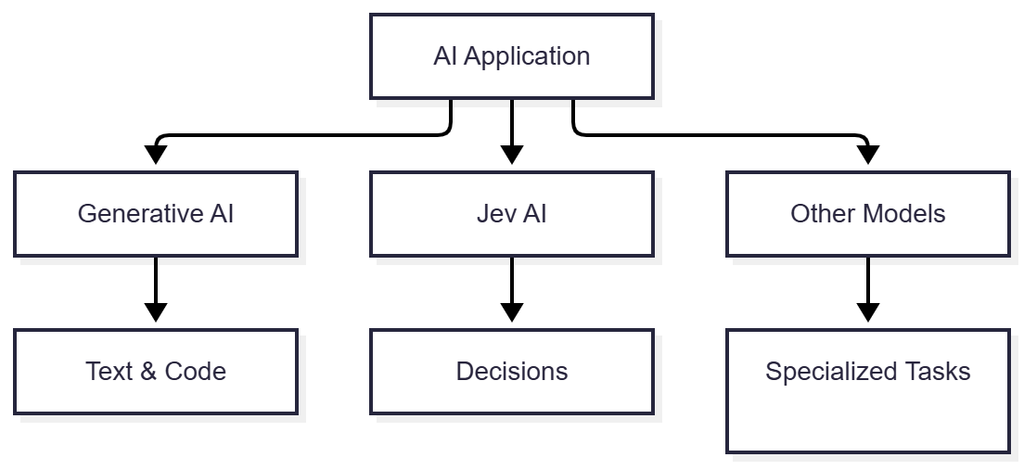
This could become useful as AI applications become more complex.
3. Security Systems
Security software constantly makes decisions.
For example:
- Is this request suspicious?
- Should this action require additional verification?
- Should this event be escalated?
- Which security workflow should handle it?
A structured decision model can potentially sit between incoming information and automated security actions.
For high-risk systems, however, automated decisions should still be tested carefully and combined with appropriate human-review mechanisms.
4. Content Classification
Large websites receive enormous amounts of content.
A system might need to determine:
- Content category
- Topic
- Priority
- Moderation status
- Language
- Routing destination
A decision-focused AI model could perform these repetitive classifications without generating a full explanation every time.
5. AI Safety and Guardrails
AI agents can interact with tools, databases and external services.
Before an agent executes an important operation, another model could evaluate the proposed action.
For example:
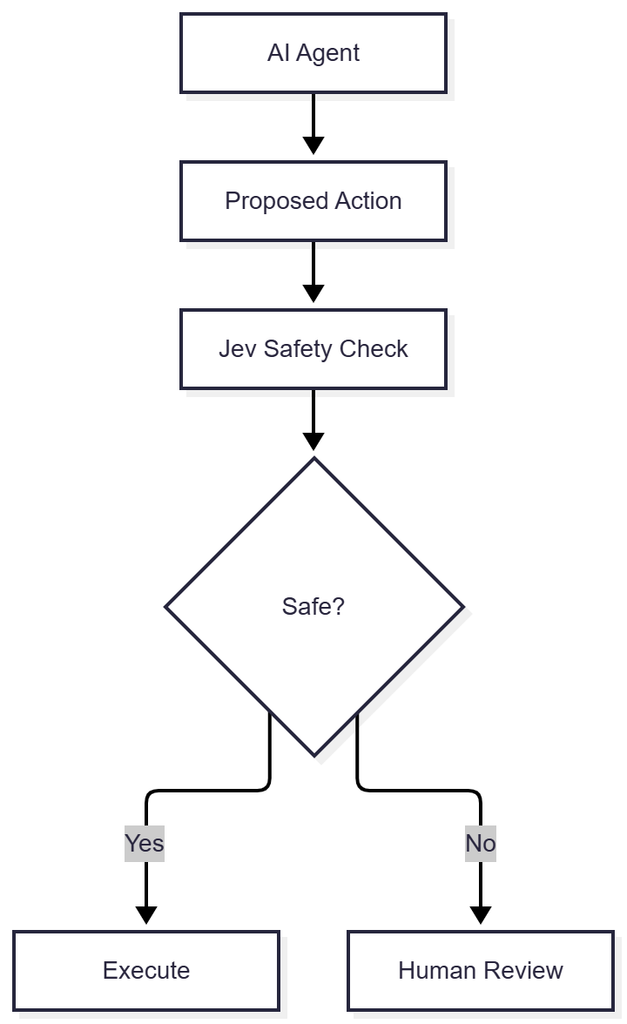
This is one of the more interesting potential uses of decision-focused AI.
What Are the Advantages of Jev’s Approach?
The model’s architecture offers several potential advantages for certain workloads.
Structured outputs
Because developers define the expected output, applications do not have to interpret an unrestricted paragraph.
Fast decisions
Jev is designed for rapid decision-making rather than long-form generation.
Confidence information
The system can provide probability or confidence information that developers can incorporate into their workflows.
Lower computational requirements for narrow tasks
A system that only needs a classification or decision does not necessarily need a model generating hundreds of tokens of explanation.
Easier software integration
Structured outputs can be directly connected to application logic.
For example:
if (decision === “billing”) {
routeToBilling();
}
The AI becomes one component inside the application instead of the entire application interface.
What Are the Limitations of Jev AI?
Jev’s biggest strength is also its biggest limitation.
It is designed for a constrained decision space.
That means it is not the natural choice for every AI task.
For example, if you ask:
“Write a 2,000-word article explaining Kubernetes.”
A decision model is obviously not the right tool.
Similarly, tasks such as:
- Creative writing
- Detailed explanations
- Code generation
- Open-ended conversations
- Storytelling
- Long-form summarization
are better suited to generative models.
There is also another important consideration.
A structured output does not automatically mean a correct decision.
Jev can be prevented from inventing an entirely new category when the available choices are predefined, but it can still choose the wrong option.
Therefore, developers still need:
- Testing
- Evaluation
- Monitoring
- Appropriate confidence thresholds
- Human review for sensitive decisions
- Clear fallback behavior
AI reliability is ultimately a system-design problem, not simply a model feature.
Why Developers Are Paying Attention to Jev
The AI industry has spent years focusing on increasingly powerful generative models.
Jev represents a different question:
What if AI does not always need to generate something?
Many software applications contain thousands of small decisions.
A support platform decides where a ticket should go.
A security platform decides whether an event deserves attention.
An AI agent decides which tool to call.
An e-commerce system decides how to categorize a request.
A workflow engine decides whether a task should continue.
These decisions may be simple individually, but they happen repeatedly at scale.
Jev’s approach is designed specifically around this type of workload.
The model has also gained significant attention among developers since its September 2026 release, with reports describing rapid experimentation and integrations around developer tooling.
Jev AI and the Future of AI Agents
One of the most interesting areas for Jev could be AI agents.
An AI agent typically needs to perform a sequence of decisions:
Understand task
↓
Choose tool
↓
Execute tool
↓
Evaluate result
↓
Continue or stop
↓
Return answer
Not every step requires a large language model.
A generative model could handle complex reasoning and communication, while a specialized decision model could handle smaller, repetitive decisions.
This could create hybrid AI architectures.
For example:
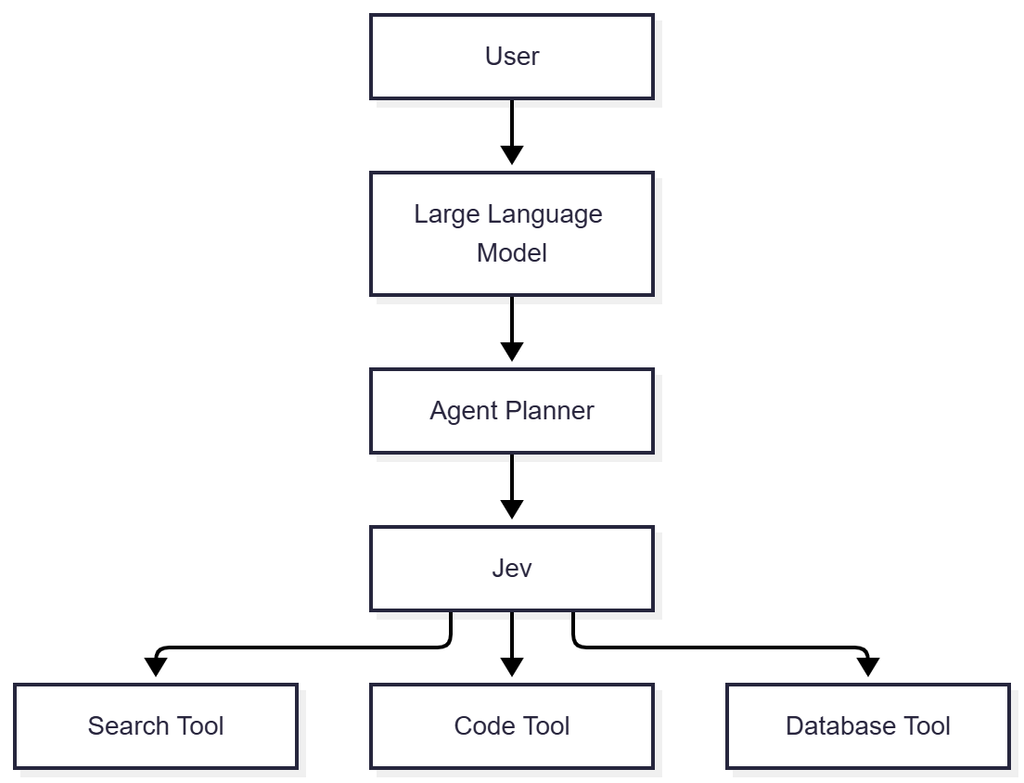
In this architecture, Jev is not replacing the main AI model.
It acts as a specialized decision component.
Is Jev AI the Future of Artificial Intelligence?
It is too early to make that conclusion.
Jev is still a new technology, and its long-term adoption will depend on factors such as:
- Real-world performance
- Reliability
- Pricing
- Developer adoption
- API availability
- Integration options
- Competition from existing AI providers
- Performance on production workloads
What is already clear is that Jev represents an interesting shift in how developers can think about AI.
AI does not always have to be a chatbot.
Sometimes an application simply needs an intelligent function that answers:
Which option?
How urgent?
Should this continue?
Which tool?
Does this require review?
For those problems, a decision-focused model can be a useful architectural idea.
Jev AI vs Generative AI: The Bigger Picture
The future of AI may not be about choosing between one model and another.
Instead, applications could use multiple specialized models.
A simplified architecture could look like this:
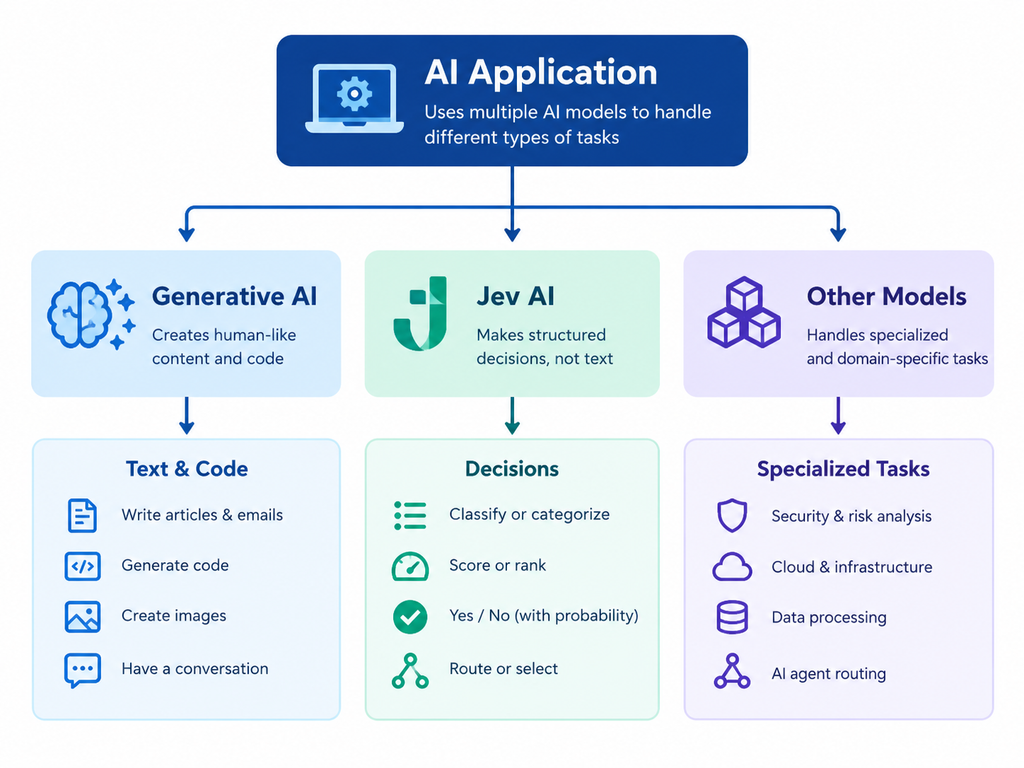
Generative AI can handle open-ended work.
Decision models can handle structured choices.
Specialized models can handle other workloads.
The developer can combine these systems according to the application’s requirements.
This could lead to AI systems that are less dependent on one giant model for every task.
Final Thoughts
Jev AI is interesting not because it tries to become another chatbot, but because it questions whether every AI problem needs a chatbot-style solution.
Developed by TypeSafe AI, Jev focuses on structured, probabilistic decisions instead of free-form text generation. That makes it particularly relevant to developers building automation systems, AI agents, routing systems, classification pipelines and software guardrails.
It also highlights a broader trend in artificial intelligence.
As AI moves deeper into software infrastructure, applications will need more than models that can write impressive answers. They will also need systems that can make fast, predictable decisions that software can act upon.
Jev is an early example of that approach.
Whether decision-focused models become a major category of AI remains to be seen, but the underlying idea is significant: the next generation of AI applications may use different models for different kinds of intelligence rather than relying on one model to do everything.