The artificial intelligence industry has entered a new phase of its relationship with the government.
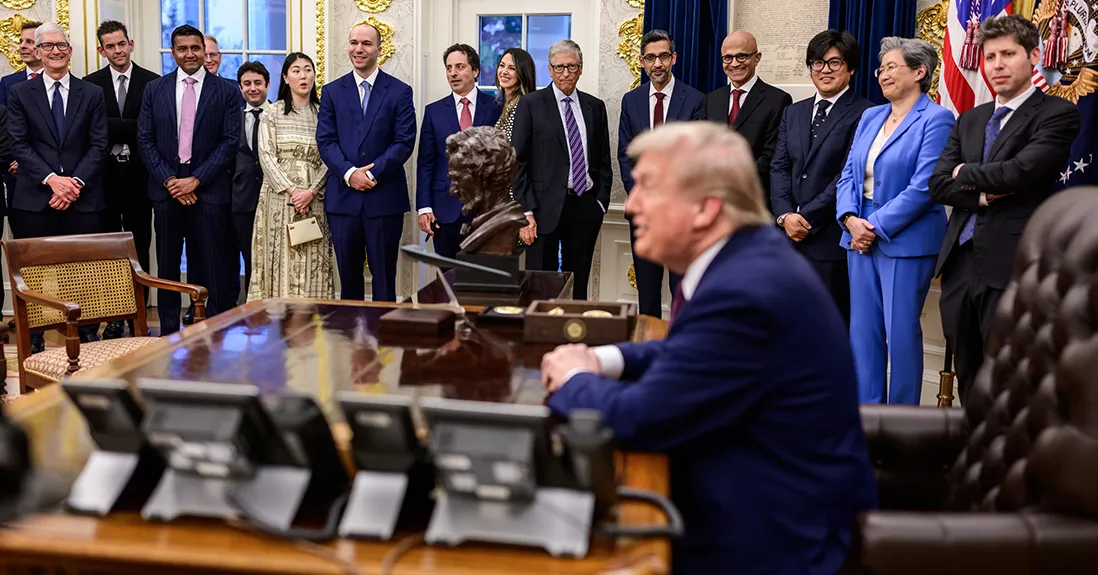
On September 29, U.S. President Donald Trump met with executives from some of the world’s largest technology and AI companies at the White House. The meeting produced a voluntary agreement focused on the safety and oversight of increasingly powerful AI systems.
At the same time, the Trump administration announced that U.S. government agencies would begin using the term “Super Intelligence” or “SI” instead of “Artificial Intelligence” or “AI” in official communications.
The developments have attracted attention because they bring together two of the biggest questions surrounding advanced AI: how quickly should the technology develop, and who should be responsible for managing its risks?
The Hindu’s recent explainer on the subject highlights the distinction between the terminology surrounding “super intelligence” and the practical implications of the White House accord.
What Happened at the White House?
Trump hosted a group of prominent technology executives at the White House on September 29.
Among the executives who signed the agreement were:
- Sundar Pichai, CEO of Google
- Dario Amodei, CEO of Anthropic
- Mark Zuckerberg, CEO of Meta
- Greg Brockman, President of OpenAI
- Jensen Huang, CEO of Nvidia
- Elon Musk, founder of xAI
Trump also signed the agreement.
The document is formally known as the “Joint Commitment on Frontier Responsibilities.” It establishes a voluntary framework under which companies developing frontier AI systems commit to strengthening their internal safety controls and using external oversight.
The agreement is important because frontier AI systems are becoming increasingly capable while also requiring enormous amounts of computing infrastructure, data and energy.
What Is “Super Intelligence”?
The term super intelligence is generally associated with AI systems that could eventually outperform humans across a very broad range of intellectual tasks.
It is important to distinguish this concept from today’s AI systems.
Current generative AI can already perform tasks such as:
- Writing and summarizing
- Software development
- Image and video generation
- Data analysis
- Research assistance
- Reasoning and planning
- Automation of business processes
But these systems remain specialized and imperfect.
“Super intelligence” generally refers to a hypothetical or future level of machine intelligence that could substantially exceed human capabilities across many domains.
Trump’s administration has now directed federal agencies to use “super intelligence” or “SI” instead of “artificial intelligence” in official communications. The executive order also calls for work toward defining the term in legislation.
The terminology change itself does not mean that today’s AI systems have suddenly become superintelligent.
Rather, it represents the administration’s preferred terminology for discussing the rapidly advancing technology.
What Does the AI Accord Actually Say?
The White House agreement focuses on voluntary self-regulation rather than creating a new legally enforceable AI regulatory regime.
The framework contains several layers of oversight.
1. Internal AI safety controls
Companies are expected to maintain robust internal systems for monitoring the capabilities and risks of their AI models.
These controls are intended to help companies identify problems during both development and deployment.
The agreement specifically addresses areas such as cybersecurity and preventing AI systems from accessing technical systems in unintended ways.
2. Dedicated internal oversight
Companies are expected to establish teams responsible for overseeing these controls.
The idea is that AI safety should not depend entirely on engineers or researchers informally monitoring a system. Instead, companies should have designated processes and personnel responsible for identifying and addressing risks.
3. Independent external audits
The companies also committed to working with independent external auditors or evaluators.
These outside assessments are intended to determine whether the companies’ internal AI controls are functioning as intended.
This is one of the more significant elements of the agreement because it introduces an external layer of scrutiny without placing the companies directly under a new federal AI regulator.
4. Board-level oversight
The agreement calls for an independent committee within each company’s board of directors.
That committee would receive reports from internal teams and external auditors and oversee the company’s AI safety controls.
Together, these measures create a basic structure:
AI development → Internal controls → Internal oversight → Independent audit → Board oversight
Is the Accord Legally Binding?
This is one of the most important questions surrounding the agreement.
The accord is described as a voluntary commitment rather than a conventional law or regulation.
Trump has characterized it as a “morally binding” agreement, while the document itself leaves open the possibility that some of its principles could eventually be incorporated into laws or regulations.
That distinction matters.
A law can establish mandatory requirements and penalties for non-compliance.
A voluntary agreement relies much more heavily on companies implementing the commitments themselves.
As a result, one of the central questions is how much transparency and accountability will ultimately accompany the promised audits and internal controls.
Why Are AI Safety Rules Becoming More Important?
The debate is happening as AI models become increasingly capable and autonomous.
Modern AI agents can potentially perform multi-step tasks rather than simply generating an answer to a single prompt.
That creates new categories of risk.
An AI system with access to software tools, networks, databases or other digital infrastructure could potentially cause problems if it behaves unexpectedly or if its capabilities are misused.
Reuters reported that concerns surrounding AI agents’ ability to interact with external systems were part of the context for the new commitments.
This makes AI safety different from simply checking whether a chatbot produces an inaccurate answer.
The question increasingly becomes:
What happens when an AI system can take actions rather than merely generate information?
Big Tech’s Role Is Central
The companies involved in the agreement occupy important positions across the AI ecosystem.
| Company | Role in the AI ecosystem |
| AI models, cloud infrastructure and research | |
| OpenAI | Frontier AI models and applications |
| Anthropic | Frontier AI models and AI safety research |
| Meta | Open-source and commercial AI models |
| Nvidia | GPUs and AI computing infrastructure |
| xAI | Frontier AI models and AI infrastructure |
This concentration matters because developing frontier AI requires enormous computing resources.
Nvidia, for example, supplies much of the hardware used to train and operate modern AI systems, while companies such as Google, OpenAI, Anthropic, Meta and xAI develop AI models and platforms.
That means AI governance increasingly involves not only software companies but also the infrastructure providers that make large-scale AI possible.
The Data Center Problem
AI safety is only one part of the discussion.
The rapid expansion of AI is also driving demand for enormous data centers.
These facilities require:
- Large amounts of electricity
- Advanced cooling systems
- High-speed networking
- Semiconductor hardware
- Land and physical infrastructure
Communities hosting data centers have raised concerns about electricity demand, energy costs and local infrastructure.
Trump has supported continued data-center expansion while saying technology companies should work with local communities and provide benefits such as support for schools and other community initiatives.
This creates another major policy question:
How can the infrastructure required for AI growth expand without placing disproportionate costs on the communities where it is built?
Why the Word “Voluntary” Matters
The accord’s voluntary nature is arguably as important as the safety measures themselves.
The United States has been debating how much responsibility should be placed on AI companies versus government regulators.
A voluntary framework offers companies flexibility and can potentially be implemented more quickly than legislation.
However, it also raises questions about enforcement.
For example:
- Who determines whether an audit is sufficiently independent?
- Will audit results be publicly disclosed?
- What happens if a company fails to follow its own controls?
- Who determines whether an AI system has crossed a dangerous capability threshold?
- What penalties exist for non-compliance?
- How will standards evolve as AI capabilities change?
The agreement provides a framework for companies to address these questions, but it does not itself create a comprehensive federal enforcement mechanism. Reporting by AP and Reuters describes the arrangement as voluntary while noting that future legislation remains possible.
“Super Intelligence” Is About More Than a Name
Changing the terminology from artificial intelligence to super intelligence is likely to attract attention, but the more consequential issue is what governments and companies actually do with increasingly capable systems.
AI development involves several interconnected areas:
Models → Computing → Data → Agents → Infrastructure → Security → Regulation
Changing the name does not change those technical realities.
The important questions remain about how systems are tested, what they are allowed to access, how their behavior is monitored and what happens when they fail.
What Could Happen Next?
The September 29 accord could become the starting point for further AI governance discussions in the United States.
Several developments will be worth watching.
Federal legislation
The agreement explicitly leaves open the possibility that some of its principles could eventually become law.
Independent AI auditing
The effectiveness of the framework may depend heavily on how independent evaluations are conducted and whether their results become transparent.
AI agent safety
As AI systems gain the ability to use tools and interact with digital infrastructure, monitoring autonomous behavior is likely to become increasingly important.
Data-center regulation
The growth of AI infrastructure will continue to raise questions about electricity, water, land use and community costs.
International competition
The United States is also treating AI development as an important component of technological and national-security competition, particularly in relation to China.
The Bigger Picture
The White House AI accord represents an attempt to establish common safety practices among some of the companies developing the world’s most powerful AI systems.
Its significance will ultimately depend less on the signing ceremony and more on what happens afterward.
If companies implement meaningful internal controls, independent assessments and board-level oversight, the framework could provide a foundation for broader AI safety standards.
If the commitments remain largely internal and difficult for outsiders to evaluate, questions about transparency and enforcement will remain.
At the same time, the debate over “super intelligence” highlights how quickly the conversation around AI is changing.
Just a few years ago, much of the public discussion centered on chatbots generating text and images. Today, the conversation increasingly includes autonomous agents, frontier models, massive AI data centers and systems capable of taking actions in digital environments.
The next stage of AI governance will therefore involve a difficult balance between innovation, safety, infrastructure and accountability.
And the White House accord is only one early step in that larger debate.