
Anthropic is making another enormous bet on computing infrastructure.
The company behind Claude has agreed to spend $11.6 billion over seven years on Akamai cloud infrastructure, in what Akamai describes as the largest deal in its history.
But the headline number only tells part of the story.
The agreement is notable not simply because of its size. It shows how the AI industry is moving beyond the race for GPUs and toward a much broader infrastructure battle involving CPUs, cloud capacity, networking, memory, data centers and distributed computing.
And there is an unusual twist: Anthropic is also receiving a warrant that could allow it to acquire a stake of approximately 5% of Akamai, depending on how much the relationship expands.
The initial agreement could also grow by another $9 billion, potentially taking the total commitment to approximately $20 billion.
So what exactly is Anthropic buying, why does Akamai need billions of dollars to fulfill the agreement, and what does this tell us about where AI infrastructure is heading?
Let’s break it down.
The $11.6 Billion Anthropic-Akamai Deal Explained
On September 24, Akamai announced a seven-year cloud services agreement with Anthropic worth approximately $11.6 billion.
Under the agreement, Anthropic will use Akamai Cloud’s distributed infrastructure and software to support growing computing requirements, particularly CPU workloads.
The deal is structured around infrastructure delivered over several years rather than Anthropic simply transferring $11.6 billion upfront.
Akamai expects to invest heavily to build the capacity needed to support the agreement.
The company estimates approximately $5.5 billion in capital expenditure associated with the deal.
It also expects to add around $1.7 billion to its 2026 capital spending, including spending related to securing components such as memory.
The numbers at a glance
| Deal detail | What it means |
| Initial commitment | Approximately $11.6 billion |
| Contract length | 7 years |
| Potential expansion | Up to $9 billion |
| Potential total | Approximately $20 billion |
| Main workload highlighted | CPU computing |
| Akamai estimated CapEx | Approximately $5.5 billion |
| Additional 2026 CapEx | Approximately $1.7 billion |
| Anthropic warrant | Up to approximately 5% of Akamai |
The agreement is subject to delivery and service-availability conditions, so the $11.6 billion should not be interpreted as an unconditional immediate payment.
Why Is Anthropic Spending Billions on CPUs?
This is perhaps the most interesting part of the deal.
When people talk about AI infrastructure, they usually talk about GPUs.
Nvidia’s GPUs have become synonymous with large-scale AI computing because modern AI models depend heavily on accelerated parallel processing.
But an AI platform isn’t just a collection of GPUs.
Behind every AI service is a much larger software and infrastructure stack.
Think about what happens when you ask Claude to analyze a document.
Your request might pass through:

The GPU or AI accelerator may perform an important part of the model computation.
But CPUs still perform many general-purpose tasks surrounding the model.
As AI applications become more sophisticated, those supporting workloads can become increasingly significant.
TechCrunch reported that Akamai’s deal specifically represents a bet on this less-publicized part of AI infrastructure, particularly as AI agents take on more tasks involving software execution and web interaction.
The AI Infrastructure Story Is Getting Bigger Than GPUs
This deal is another reminder that the AI infrastructure market is becoming much broader.
The simplified version of the AI boom looks like this:
More AI models → more GPUs
But the real infrastructure equation is closer to:
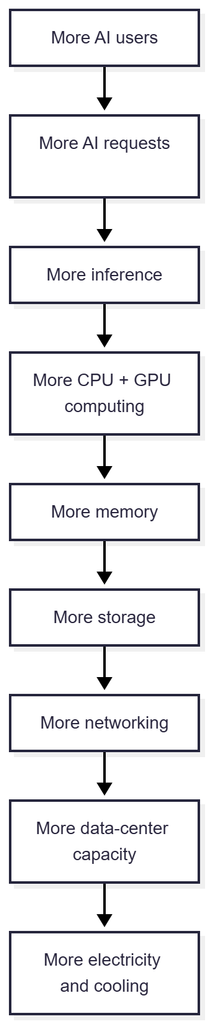
The Anthropic-Akamai agreement sits inside this much larger infrastructure chain.
That is why the deal matters beyond the two companies involved.
Akamai Is Trying to Become More Than a Content Delivery Company
For years, Akamai has been closely associated with content delivery networks, internet performance and cybersecurity.
Its network is distributed across a large number of locations around the world.
Now the company is pushing further into cloud computing.
Akamai says its cloud infrastructure is designed to provide distributed computing from the core toward the edge, rather than relying exclusively on centralized data centers.
That creates an interesting proposition for AI workloads.
Instead of thinking about cloud infrastructure as a few giant centralized facilities, distributed computing allows workloads to be placed across a broader infrastructure footprint.
For some applications, that can have advantages related to:
- latency,
- geographic distribution,
- network performance,
- availability,
- application delivery,
- security,
- and workload placement.
Anthropic’s deal gives Akamai a major opportunity to demonstrate that strategy at enormous scale.
The $20 Billion Number Is Even More Interesting
The initial agreement is worth approximately $11.6 billion.
But it could become much larger.
The agreement allows for an additional $9 billion of potential expansion.
If the expansion is fully realized, the total commitment could reach approximately:
$20 Billion
That isn’t guaranteed spending under the initial agreement.
Instead, it represents the potential size of the relationship if Anthropic expands its purchases.
The structure is also connected to the equity warrant given to Anthropic.
Anthropic Could Receive Up to 5% of Akamai
This is where the deal becomes particularly unusual.
Akamai issued Anthropic a warrant representing the right to acquire shares equivalent to approximately 5% of Akamai’s outstanding common stock, subject to the agreement’s conditions.
The warrant covers approximately 7.7 million shares at an exercise price of $111.33 per share.
Approximately 2% is tied to the initial commitment.
The remaining portion is connected to additional spending.
According to TechCrunch, additional spending milestones can unlock roughly another 1% for each $3 billion of additional commitment, up to the overall limit.
That creates an unusual relationship.
Normally, investors are accustomed to seeing cloud providers, chip companies or other infrastructure companies invest in AI companies.
Here, the customer is receiving an opportunity to acquire part of the infrastructure provider.
Why Would Akamai Give Anthropic an Equity Warrant?
The structure ties the two companies’ interests together.
Anthropic has an incentive to expand its use of Akamai’s infrastructure if it determines that the service meets its requirements.
Akamai, meanwhile, has an incentive to build enough capacity and successfully deliver the infrastructure required by Anthropic.
It is also a way of linking part of the potential equity value to the expansion of the commercial relationship.
The arrangement is notable because Akamai has not traditionally used this type of warrant structure for its cloud deals. TechCrunch reported that this is the first time Akamai has attached a warrant to a cloud agreement.
Akamai Is Spending Billions Before It Gets the Full Benefit
There is another side to the story.
Akamai cannot simply announce an $11.6 billion contract and immediately collect the entire amount.
It needs infrastructure.
That means servers.
Memory.
Networking equipment.
Data-center capacity.
Power.
Cooling.
And other components.
Akamai estimates it will spend approximately $5.5 billion in capital expenditure associated with the agreement.
The company is also increasing 2026 capital spending by approximately $1.7 billion, including efforts to secure components ahead of deployment.
This is an important characteristic of the current AI infrastructure boom.
AI demand is forcing infrastructure companies to invest ahead of future consumption.
When Will Akamai Actually See Revenue?
The agreement doesn’t immediately translate into billions of dollars of revenue for Akamai.
According to TechCrunch’s reporting from Akamai’s investor call, the company expects approximately $150 million to $300 million of revenue in 2027, beginning in the second half of the year.
Akamai expects the revenue generated by the agreement to reach an annualized pace of approximately $1.7 billion by the end of 2028.
That timeline illustrates how large cloud infrastructure contracts work.
The customer commits to substantial future capacity.
The provider then builds that capacity.
Infrastructure is deployed.
Workloads migrate onto the platform.
Revenue grows as the customer consumes the service.
So the $11.6 billion headline should be viewed as a long-term infrastructure commitment, not an immediate revenue injection.
Anthropic’s Cloud Strategy Is Getting More Complicated
The Akamai deal also arrives at an interesting time for Anthropic.
The company is rapidly expanding its AI infrastructure footprint while working with multiple technology partners.
Anthropic has relationships involving companies including Amazon, Google, Microsoft and AMD, among others.
Its latest Akamai agreement adds another major infrastructure relationship to that ecosystem.
That can provide access to additional capacity and different infrastructure architectures.
But it also makes Anthropic’s infrastructure strategy increasingly complex.
The company has to manage:
- multiple cloud providers,
- different hardware platforms,
- networking environments,
- data-storage systems,
- security controls,
- capacity planning,
- and long-term infrastructure commitments.
This is increasingly becoming an infrastructure-management challenge as much as an AI-model challenge.
Why AI Companies Are Looking Beyond Traditional Cloud Infrastructure
There is a simple reason.
AI workloads are growing extremely quickly.
If every AI company competed for capacity from the same handful of hyperscale providers, infrastructure constraints could become increasingly important.
Distributed cloud providers can therefore play another role in the ecosystem.
A company such as Akamai can potentially offer infrastructure in locations and configurations that differ from traditional centralized cloud deployments.
For AI inference, latency can matter.
For AI agents, responsiveness can matter.
For global applications, geographic distribution can matter.
And for businesses, reliability and security matter.
The AI cloud market is therefore likely to involve more than just the biggest traditional hyperscalers.
The AI Agent Connection
There is another reason CPU capacity deserves attention.
AI agents are increasingly designed to do more than generate text.
An agent may:
- execute code,
- browse websites,
- call APIs,
- manipulate files,
- interact with software,
- process information,
- perform multi-step tasks,
- and operate for longer periods.
Those workloads can generate significant amounts of general-purpose computing activity around the actual model inference.
That means the AI agent boom could increase demand for infrastructure that isn’t traditionally described as “AI hardware.”
The Anthropic-Akamai agreement provides a real-world example of that broader infrastructure requirement.
What This Means for Developers
Developers don’t need to spend billions on cloud infrastructure to benefit from understanding this trend.
But the architecture of AI applications is changing.
A modern AI application may look something like:
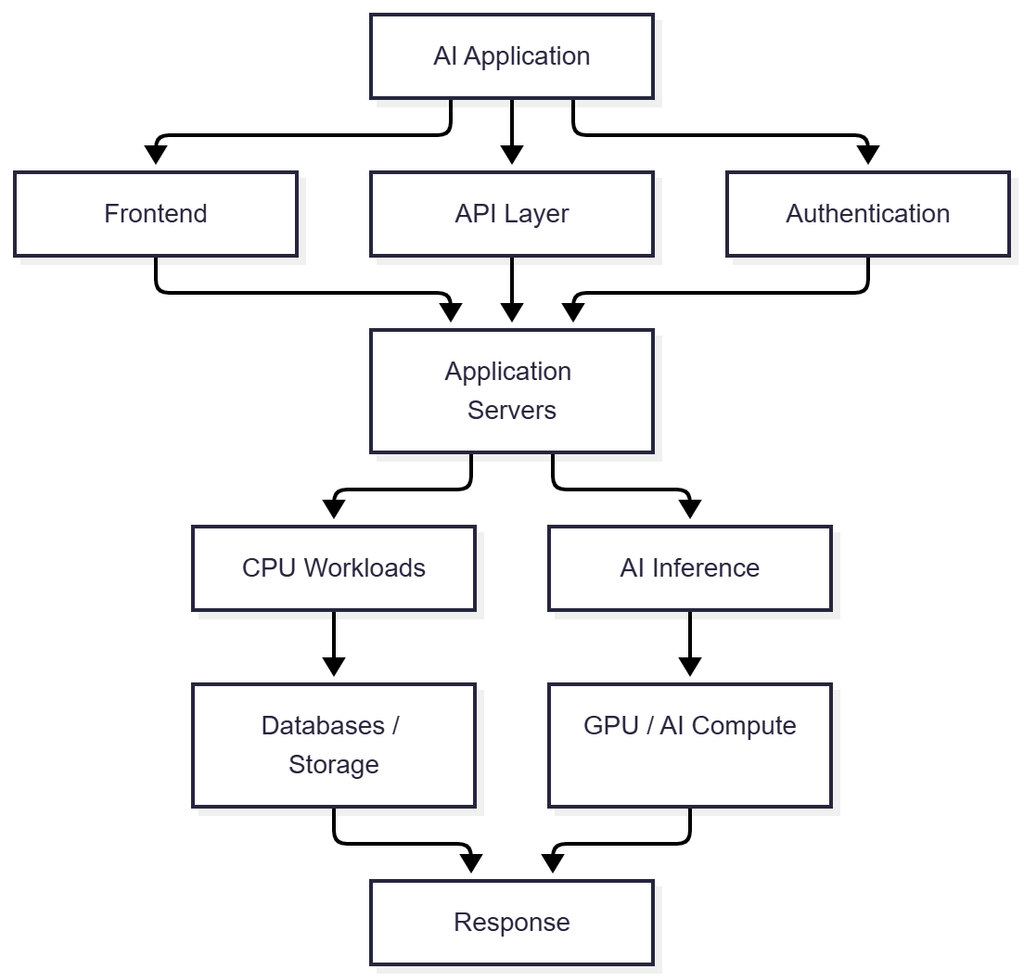
Understanding this architecture is becoming increasingly important for developers building AI-powered products.
The model itself is only one component.
What Businesses Should Take Away
For businesses adopting AI, the Akamai-Anthropic deal highlights an important question:
What infrastructure will support your AI application when usage grows?
A prototype may work perfectly with a simple API.
A production application with thousands or millions of users is different.
Businesses need to consider:
Scalability
Can infrastructure handle rapidly increasing workloads?
Latency
How quickly can requests be processed?
Reliability
What happens if one infrastructure component becomes unavailable?
Security
How is business and customer data protected?
Cost
What happens to infrastructure costs when AI usage increases?
Vendor dependence
What happens if an application becomes heavily dependent on one cloud or AI provider?
These questions are becoming part of normal AI application architecture.
The Bigger AI Infrastructure Race
The Anthropic-Akamai agreement is just one piece of a much larger infrastructure expansion.
AI companies are signing enormous contracts for computing capacity.
Cloud providers are building new facilities.
Chip companies are expanding production.
Data-center operators are securing power.
Memory suppliers are increasing capacity.
Networking companies are developing faster systems.
And infrastructure providers are racing to support AI workloads outside traditional hyperscale environments.
The result is a new layer of competition.
The AI race isn’t happening only between model developers.
It is also happening underneath them.
Who has the compute?
Who has the networking?
Who has the power?
Who can build the capacity fast enough?
Those questions may become increasingly important as AI usage continues to expand.
Why This Deal Matters
The $11.6 billion figure is impressive, but the more important story is what the agreement says about the evolution of AI.
The industry is moving from:
AI models
to
AI systems
to
AI infrastructure ecosystems.
And those ecosystems require far more than GPUs.
They require CPUs, memory, networking, storage, cloud platforms, cybersecurity and globally distributed infrastructure.
Akamai is betting that its distributed cloud network can become an important part of that ecosystem.
Anthropic is committing billions of dollars to make use of it.
Final Takeaway
Anthropic’s seven-year, $11.6 billion agreement with Akamai is one of the clearest recent examples of how quickly AI infrastructure requirements are expanding.
The deal could eventually grow to approximately $20 billion, while Akamai expects to invest around $5.5 billion in capital expenditure to support the relationship. Anthropic also received a warrant that could represent approximately 5% of Akamai’s outstanding stock, depending on the agreement’s expansion.
But the biggest takeaway isn’t simply the size of the contract.
It’s the infrastructure behind it.
The future of AI will require enormous amounts of computing power, and not all of that computing will happen on GPUs.
As AI agents become more capable and AI applications become more deeply integrated into everyday software, the demand for CPU computing, distributed cloud infrastructure, networking and edge capacity could become an increasingly important part of the industry’s growth story.
The Anthropic-Akamai deal is a glimpse of that future.
And the next phase of the AI race may be fought not just over who builds the smartest model — but over who can provide the infrastructure to run it at global scale.
Key Facts
- Deal: Anthropic–Akamai cloud infrastructure agreement
- Value: Approximately $11.6 billion
- Duration: Seven years
- Potential expansion: Additional $9 billion
- Potential total: Approximately $20 billion
- Focus: Distributed cloud infrastructure and CPU workloads
- Akamai estimated CapEx: Approximately $5.5 billion
- Anthropic warrant: Up to approximately 5% of Akamai
- Announcement: September 24, 2026
Sources: Akamai’s announcement and filings; Reuters; TechCrunch.