
Introduction
When potential customers search for products or services nearby, your business has only a few seconds to appear in the search results before they choose a competitor. Whether someone searches for “best bakery near me,” “electrician in Bangalore,” or “coffee shop open now,” local search results often determine which business earns the next customer.
Unfortunately, many small businesses invest in websites but overlook local SEO. An incomplete Google Business Profile, inconsistent business information across directories, poor review management, or missing location-specific content can significantly reduce online visibility.
Local SEO helps businesses appear in Google Search, Google Maps, and other local search platforms, increasing both online and in-store traffic. Unlike traditional SEO, local SEO focuses on attracting customers within a specific geographic area who are actively looking for nearby services.
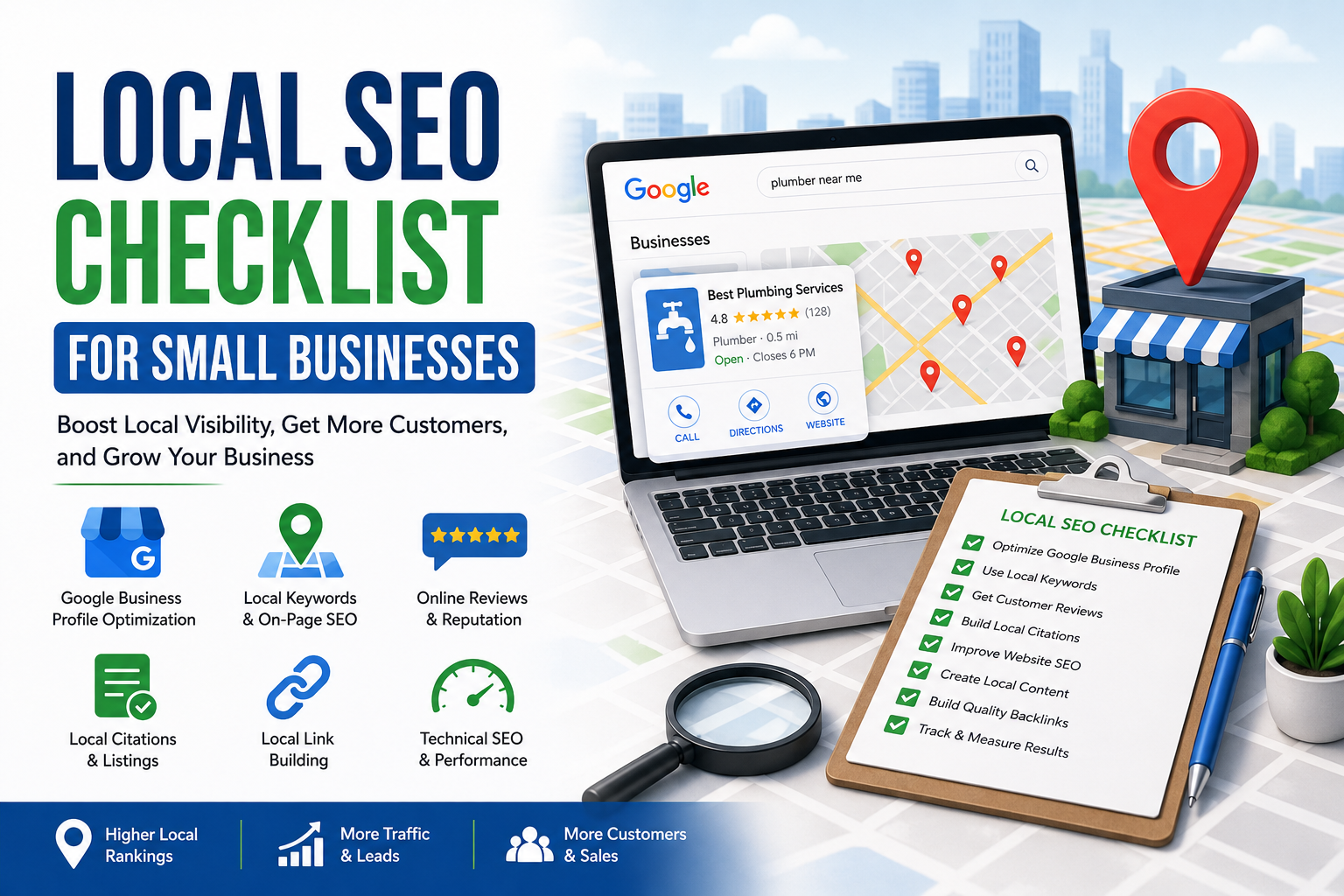
In this guide, you’ll learn a practical Local SEO Checklist for Small Businesses covering everything from optimizing your Google Business Profile to building citations, collecting customer reviews, improving website performance, and tracking results. Whether you’re launching a new business or improving an existing website, this checklist will help you strengthen your local online presence.
Key Takeaways
- Optimize your Google Business Profile completely.
- Maintain consistent business information (NAP) everywhere online.
- Use location-specific keywords naturally across your website.
- Encourage genuine customer reviews and respond professionally.
- Build local citations from trusted directories.
- Create useful local content targeting your service areas.
- Improve website speed, mobile usability, and technical SEO.
- Monitor local rankings and continuously optimize your strategy.
Why Local SEO Matters
Local SEO is the process of optimizing your online presence so customers in a specific geographic area can easily discover your business through search engines.
Unlike traditional SEO, which targets national or global audiences, local SEO focuses on nearby customers with immediate buying intent.
For example:
- A dentist wants patients within 10 km.
- A restaurant serves customers in one city.
- A plumber operates within specific neighborhoods.
These businesses benefit far more from local visibility than from ranking nationally.
Benefits include:
- Higher Google Maps visibility
- Increased phone calls
- More website visits
- Better in-store traffic
- Higher conversion rates
- Stronger brand credibility
Understanding How Local SEO Works
Google evaluates several factors before displaying local businesses.
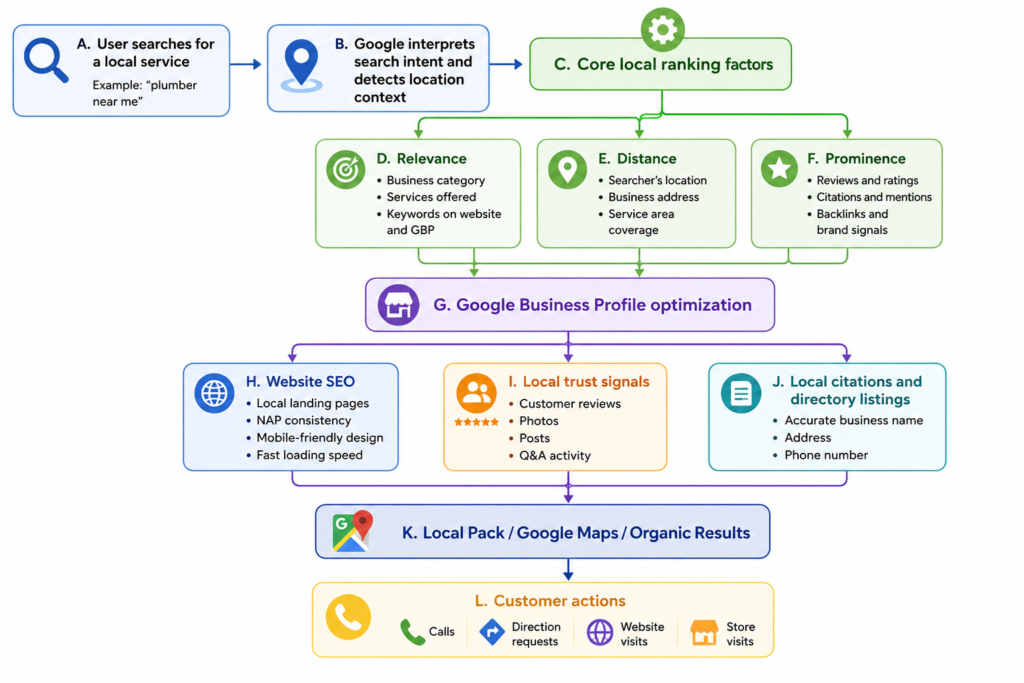
Google primarily considers:
- Relevance
- Distance
- Prominence
Businesses that satisfy these signals are more likely to appear in the Local Pack and Google Maps.
Complete Local SEO Checklist
1. Claim Your Google Business Profile
This is the single most important step.
Complete every section, including:
- Business name
- Address
- Phone number
- Website
- Business category
- Secondary categories
- Working hours
- Holiday hours
- Services
- Products
- Photos
- Logo
- Description
- Attributes
Example
Instead of:
ABC Solutions
Use:
ABC Solutions – Web Design & SEO Agency
(Only if it matches your real-world branding.)
2. Verify Business Ownership
Verification proves ownership and unlocks advanced features like:
- Insights
- Reviews
- Posts
- Messaging
- Performance tracking
3. Ensure NAP Consistency
NAP stands for:
- Name
- Address
- Phone Number
Every directory should contain identical information.
Incorrect:
ABC Technologies Pvt Ltd
Another listing:
ABC Tech
These inconsistencies can confuse search engines.
4. Choose the Correct Categories
Your primary category has a significant impact on rankings.
Example:
Primary:
- Digital Marketing Agency
Secondary:
- Website Designer
- SEO Consultant
- Software Company
Choose categories that accurately reflect your services.
5. Add High-Quality Photos
Include:
- Office
- Team
- Products
- Services
- Interior
- Exterior
- Customer interactions (with permission)
Businesses with updated photos generally receive better engagement.
Local Keyword Research
Research keywords people actually search for.
Examples:
- SEO company in Bangalore
- Best plumber near me
- Home cleaning in Delhi
- Laptop repair Hyderabad
Use keywords naturally in:
- Titles
- Headings
- Meta descriptions
- URLs
- Service pages
Avoid keyword stuffing.
Optimize Location Pages
If serving multiple cities, create unique pages.
Example:
/seo-services-bangalore

/seo-services-mumbai

/seo-services-pune
Each page should include:
- Local introduction
- Services
- Customer testimonials
- FAQs
- Map
- Contact details
Never duplicate content across locations.
Improve On-Page Local SEO
Optimize:
Title Tags
Example:
Affordable SEO Services in Bangalore | EnableFlow
Meta Description
Mention:
- Location
- Primary service
- Call to action
Headings
H1
SEO Services in Bangalore
H2
Why Businesses Choose Our SEO Services
Add Local Business Schema
Schema helps search engines understand your business.
Example:
{
 "@context":"https://schema.org",
 "@type":"LocalBusiness",
 "name":"Example Business",
 "address":{
   "@type":"PostalAddress",
   "streetAddress":"123 Main Street",
   "addressLocality":"Bangalore",
   "postalCode":"560001",
   "addressCountry":"IN"
 }
}
Build Local Citations
Citations are online mentions of your business.
Popular directories include:
- Google Business Profile
- Bing Places
- Apple Maps
- Yelp
- Yellow Pages
- Local Chamber of Commerce
- Industry-specific directories
Quality matters more than quantity.
Collect Customer Reviews
Reviews influence both rankings and customer trust.
Best practices:
- Ask satisfied customers politely.
- Never buy fake reviews.
- Respond to every review.
- Thank positive reviewers.
- Address negative feedback professionally.
Example response:
Thank you for your feedback. We’re glad you had a great experience and appreciate your support.
Build Local Backlinks
Quality backlinks improve authority.
Ideas include:
- Local news websites
- Business associations
- Community events
- Sponsorships
- Educational institutions
- Local bloggers
- Industry organizations
Create Local Content
Publish content relevant to your community.
Examples:
- Local event guides
- Industry news
- Community initiatives
- Service area pages
- Customer success stories
Example:
“Top Web Design Trends for Businesses in Bangalore”
Optimize for Mobile Users
Most local searches happen on smartphones.
Ensure:
- Responsive design
- Fast loading
- Click-to-call buttons
- Easy navigation
- Readable fonts
Improve Website Speed
Compress:
- Images
- CSS
- JavaScript
Enable:
- Browser caching
- CDN
- Lazy loading
Faster websites improve user experience and search rankings.
Add Clear Contact Information
Every page should include:
- Phone number
- Address
- Contact form
- Business hours
Consistency builds trust.
Embed Google Maps
Adding an embedded map helps users locate your business easily.
Place it on:
- Contact page
- Location pages
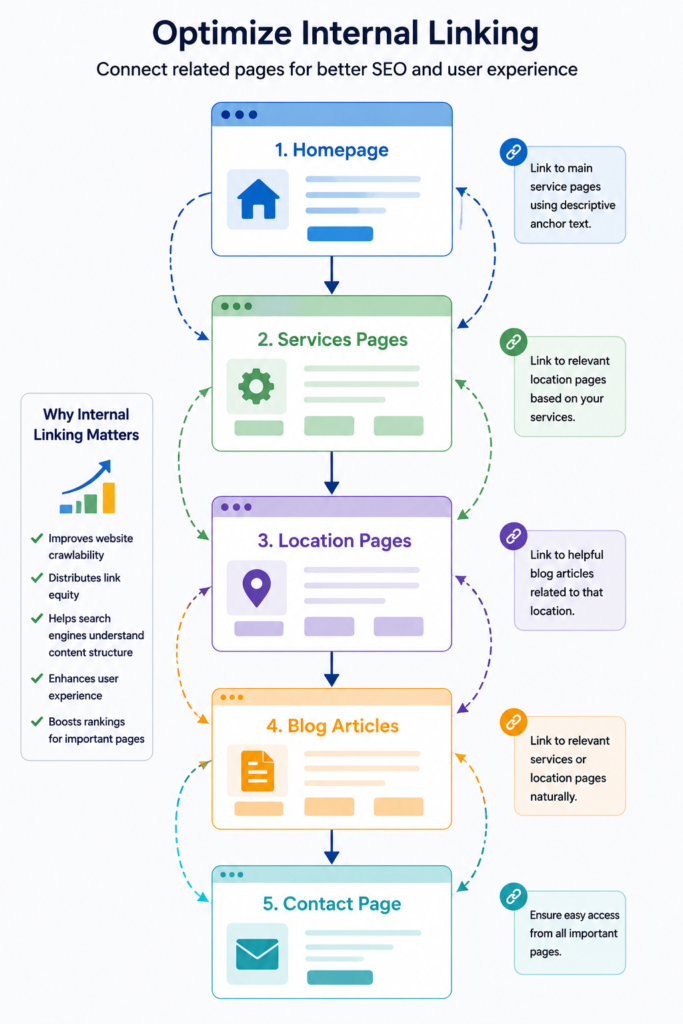
Optimize Internal Linking
Track Local SEO Performance
Monitor:
- Google Business Profile Insights
- Search Console
- Analytics
- Phone calls
- Direction requests
- Keyword rankings
- Conversion rates
Measure results monthly and refine your strategy.
Best Practices
- Keep business information updated.
- Publish fresh content regularly.
- Use high-quality original photos.
- Monitor customer reviews consistently.
- Earn authoritative local backlinks.
- Optimize for mobile devices.
- Improve website speed continuously.
- Update holiday hours and special announcements promptly.
Common Mistakes
Ignoring Google Business Profile
An incomplete profile limits visibility.
Duplicate Listings
Multiple listings confuse search engines.
Keyword Stuffing
Overusing location keywords reduces readability.
Fake Reviews
Artificial reviews can lead to penalties.
Inconsistent Contact Information
Different phone numbers or addresses weaken trust.
Slow Websites
Slow pages increase bounce rates and reduce conversions.
Pro Tips
- Add fresh photos every month.
- Publish Google Business Profile posts regularly.
- Use FAQ sections on location pages.
- Include driving directions where relevant.
- Feature customer testimonials with location references.
- Create dedicated pages for every major service area.
- Track competitors’ local search performance.
- Audit citations at least twice a year.
Frequently Asked Questions
1. What is local SEO?
Local SEO is the process of optimizing your online presence so your business appears in search results for customers searching within a specific geographic area.
2. Why is Google Business Profile important?
It powers your visibility in Google Search and Google Maps, helping customers find your business information, reviews, and location.
3. How long does local SEO take?
Most businesses begin seeing measurable improvements within three to six months, depending on competition and the quality of optimization.
4. What are local citations?
Local citations are online mentions of your business name, address, and phone number on directories, websites, and business listings.
5. Do reviews affect local rankings?
Yes. Genuine, high-quality reviews improve trust and can positively influence local search visibility.
6. Should I create separate pages for every city?
Yes, if you genuinely serve those locations. Each page should contain unique, valuable content rather than duplicated text.
7. How often should I update my Google Business Profile?
Review it regularly and update business hours, services, photos, posts, and announcements whenever changes occur.
8. Can I do local SEO without a physical storefront?
Yes. Service-area businesses can optimize for local search by configuring their service areas in Google Business Profile and maintaining accurate local information.
9. Is mobile optimization important for local SEO?
Absolutely. Since many local searches happen on mobile devices, a fast, responsive website is essential.
10. Which metrics should I track?
local citations, reviews, and local ranking strategies.